

Modified Bitumen Roofing in Mississippi: Repair, Recover, or Replace?

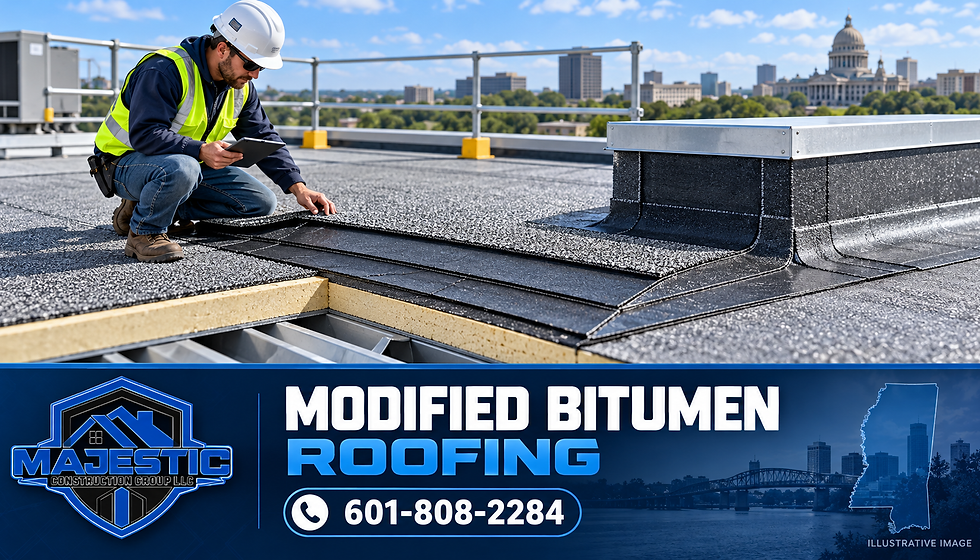
Modified bitumen is a durable multi-ply roofing option for low-slope commercial buildings, additions, canopies, and other roof areas where water does not shed like it does from a steep residential roof. The decision to repair, recover, or replace it should follow an investigation of moisture, drainage, deck condition, flashing, attachment, and the roof's overall age—not just the appearance of the cap sheet.
What modified bitumen is
Modified-bitumen membranes combine asphalt with polymer modifiers and reinforcement. SBS products are generally designed for flexibility, while APP products are formulated differently and often use installation methods suited to that membrane. Systems may be installed with approved adhesives, self-adhered sheets, hot asphalt, mechanical attachment, or torch application by trained professionals.
A typical assembly can include the structural deck, vapor or air-control components where required, insulation, cover board, base sheet, and a mineral-surfaced or coated cap sheet. The exact layers depend on the building, code, manufacturer, fire classification, wind design, and existing conditions.
Common problem areas
Leaks often begin at details rather than in the open field of a roof. Curbs, penetrations, drains, scuppers, parapets, wall transitions, laps, pitch pockets, and metal edges deserve close inspection.
Blisters, ridges, open seams, displaced surfacing, soft insulation, ponding, cracked flashings, and repeated patches provide clues, but surface appearance alone cannot show how far moisture has traveled.
Open or poorly bonded laps can admit wind-driven rain.
Ponding may accelerate coating wear and expose drainage or slope problems.
Loose edge metal can become a wind-uplift failure point.
Wet insulation can reduce thermal performance and spread damage beyond the visible leak.
Incompatible mastics or coatings can complicate a durable repair.
When a localized repair can make sense
Repair is most appropriate when the problem is isolated, the surrounding membrane remains serviceable, the substrate is sound, and moisture has not spread widely. A professional repair should remove failed material as needed, restore compatible layers, and tie new work into the existing membrane according to manufacturer requirements.
Repeatedly smearing roof cement over a moving joint or wet assembly is not a repair plan. The cause—movement, drainage, flashing geometry, attachment, or substrate failure—must be addressed.
When a recover may be considered
A recover adds a compatible new roof system over an existing assembly. It may reduce tear-off, but only when the existing roof and deck can accept the added load and the remaining materials are sufficiently dry and stable.
Core cuts, moisture surveys, adhesion or fastener testing, structural review where appropriate, code, warranty requirements, and the number of existing roof layers all affect feasibility. Wet insulation should not simply be buried.
When replacement is the responsible choice
Replacement becomes more likely when moisture is widespread, the deck is deteriorated, flashings have failed throughout, repairs are frequent, drainage requires major correction, or another recover would violate code or create an unreliable assembly.
Tear-off allows concealed conditions to be addressed: deck repair, insulation and slope redesign, new drains or scuppers, curb modifications, air sealing, and complete flashing integration.
Drainage and runoff still matter
A low-slope roof needs positive, maintainable drainage. Commercial gutters, downspouts, internal drains, scuppers, overflow paths, and discharge locations must work as a system. Commercial Gutter Installation and Repair can be part of a roof project, but capacity and discharge must match the roof area and site.
At ground level, look for erosion, ponding, water intrusion, downspout discharge near foundations, and blocked surface routes. Surface runoff is generally addressed through grading, swales, catch basins, and stable outlets. French drain installation and repair targets subsurface water and is not a universal drainage solution; soil, elevation, discharge, utilities, code, and permits must be evaluated. Call 811 and use appropriate professionals before excavation.
What Mississippi owners should request
For properties in Jackson, Pearl, Brandon, Laurel, Hattiesburg, Magee, Mendenhall, Simpson County, and Rankin County, request a written condition assessment, photos, moisture findings, repair limits, drainage observations, product compatibility, warranty terms, and a plan for protecting occupants and operations.
Roof-height inspection and repair are not DIY work. Qualified commercial roofing professionals should use appropriate access, fall protection, fire controls, and manufacturer-approved methods.
Discuss your commercial roof
Majestic Construction Group LLC provides commercial roofing evaluations, modified-bitumen repairs and replacement planning, TPO and PVC roofing, metal roofing, roof maintenance, and Commercial Gutter Installation and Repair across Central and South Mississippi. Call 601-808-2284.


Comments