
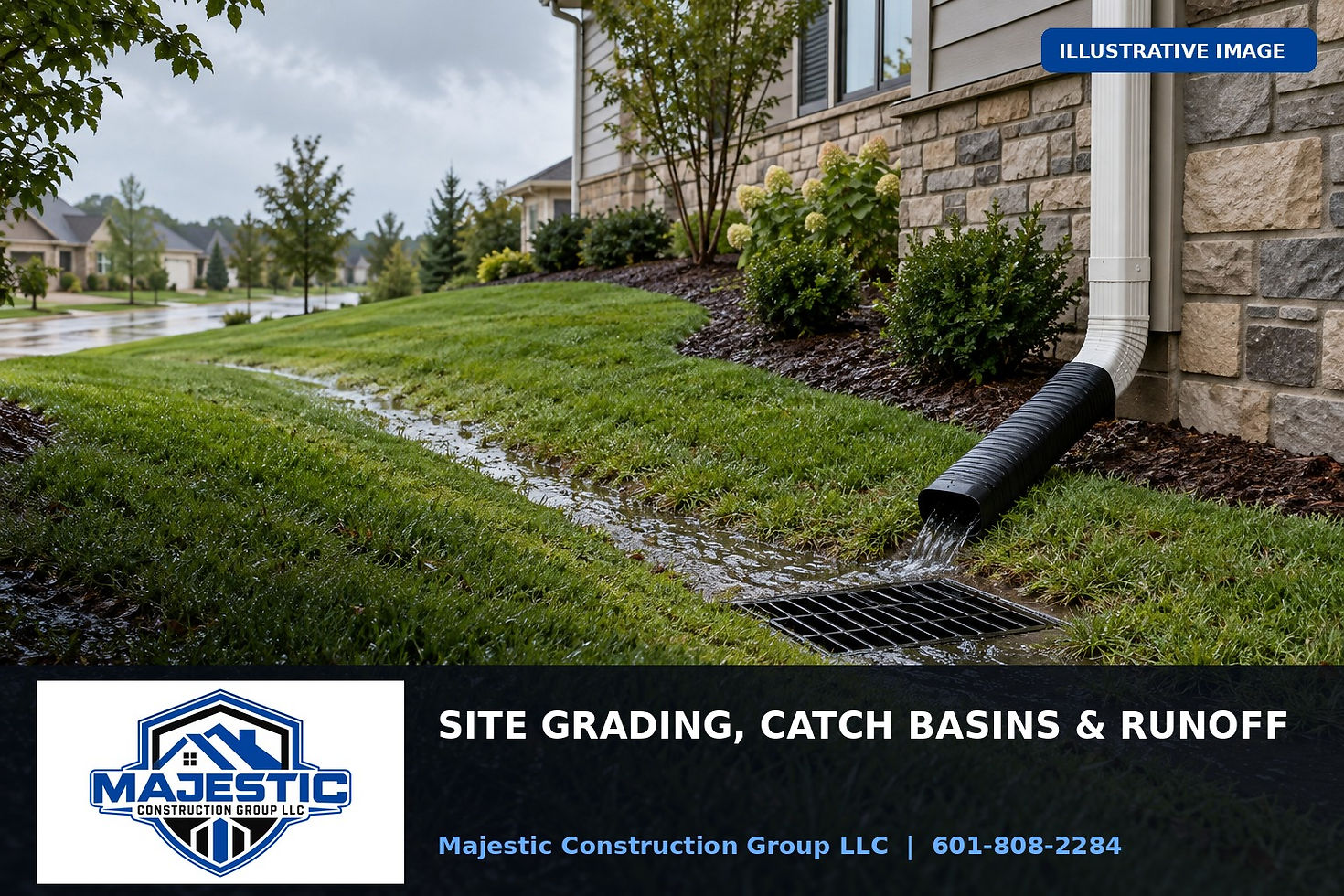
Site Grading, Catch Basins, and Downspout Extensions: Building a Better Drainage Plan


Water beside a foundation is a symptom, not a diagnosis. The source may be roof runoff, a low spot in the yard, water flowing from an uphill property, compacted soil, an undersized ditch, subsurface seepage, or several problems working together.
A reliable drainage plan matches each source to the right tool. Site grading, catch basins, downspout extensions, swales, solid conveyance pipe, French drain installation and repair, erosion control, and foundation-water management all have roles—but they are not interchangeable.
First distinguish surface runoff from subsurface water
Surface runoff travels over the ground during or soon after rain. Clues include visible sheet flow, puddles, mulch movement, erosion channels, overflowing gutters, and water collecting at low spots. Subsurface water moves through soil and may appear as persistent seepage, damp crawlspace conditions, saturated soil after surface water is gone, or water entering below grade.
A French drain is designed primarily to intercept and relieve subsurface water moving through soil. It does not automatically correct poor surface grading, clogged gutters, concentrated downspout discharge, an undersized municipal system, or water flowing across the property. Some sites need both surface and subsurface measures, designed so each has a dependable discharge point.
Map the water before choosing materials
Observe the property during rain from a safe location and note where water begins, travels, slows, and exits.
Check roof valleys, gutter capacity, outlet locations, and downspout discharge.
Identify depressions, reverse slope toward the foundation, compacted paths, and eroded areas.
Consider soil type and infiltration. Mississippi clay can accept water slowly, while sandy areas may drain differently.
Locate crawlspace vents, slab edges, door thresholds, retaining walls, utilities, septic components, and neighboring discharge.
Verify where water may legally and safely leave the property without creating erosion or harming a neighbor.
Start with the roof drainage system
A large roof concentrates thousands of gallons during heavy rain. Properly sized and maintained gutters, outlets, and downspouts reduce uncontrolled sheets of water at the foundation. Majestic offers Seamless Residential Gutters along with gutter maintenance, downspouts, and runoff handling for homes.
Downspout extensions should carry water to a stable location that continues to fall away from the building. The endpoint matters as much as the length. An extension that empties into a low spot, across a walkway, or onto erodible soil merely moves the problem a few feet.
Use grading to create continuous positive drainage
Site grading shapes the ground so water moves away from structures and toward a planned outlet. The goal is a continuous path without hidden bowls. Adding fill at the wall alone can bury siding, block weep paths, trap moisture against masonry, cover termite inspection zones, or raise soil too close to framing.
Grading work should protect required clearances and preserve drainage around patios, sidewalks, driveways, HVAC pads, and landscaping. Settlement must be anticipated, and exposed soil needs stabilization so the first storm does not wash the new grade away.
Swales spread and guide shallow surface flow
A swale is a broad, gently shaped channel that directs surface runoff while remaining mowable or landscaped. It can collect sheet flow more evenly than a narrow trench. Slope, width, soil, vegetation, expected flow, and outlet stability determine whether it performs without becoming soggy or eroding.
Catch basins collect water at defined low points
Catch basins are useful where surface water naturally concentrates—near a driveway edge, patio, courtyard, or low lawn area. The grate elevation must be low enough to receive water, and the basin needs accessible sediment space and a maintainable solid outlet pipe.
A basin is not a cure for every wet yard. If surrounding grades do not direct water toward it, the grate is too high, the outlet is flat, or the discharge point is blocked, it will disappoint. Multiple smaller inlets sometimes capture distributed flow better than one deep basin.
Solid pipe and perforated pipe serve different jobs
Solid pipe conveys collected roof or surface water without intentionally leaking it into surrounding soil.
Perforated pipe in a properly designed French drain collects subsurface water through a stone-and-filter assembly.
Roof water should not automatically be discharged into a perforated French-drain trench; during heavy rain that can load already wet soil.
Gutters with French drains can be coordinated as part of one property plan, but their collection paths and discharge details must be designed for the actual water source.
Discharge determines whether the system can work
Every drainage component needs a lawful, stable outlet with enough fall or an appropriately designed mechanical solution. Water should not be redirected onto neighboring property, toward a building, across a public sidewalk, or into a system that cannot accept it. Local rules may regulate connections to streets, ditches, storm sewers, easements, wetlands, or other drainage infrastructure.
Utilities, code, and permits come before excavation
Call 811 before any digging and allow utilities to be marked. Private lines—such as irrigation, lighting, propane, septic, well, or owner-installed electrical—may require separate locating. Deeper trenches, unstable soil, confined access, retaining walls, and work near foundations or utilities belong to qualified professionals. Confirm local code, easements, environmental rules, and permit requirements before installation.
Control erosion and protect the foundation
Fast water can undermine soil, expose footings, damage landscaping, and carry sediment into drains. Outlets may need level spreaders, appropriate stone, turf reinforcement, or other energy-dissipation measures. Foundation-water management should also address cracks, failed joints, crawlspace conditions, and exterior waterproofing when surface work alone cannot resolve intrusion.
A drainage plan should solve the source, path, and outlet
Majestic Construction Group LLC provides drainage evaluation, site grading, catch basins, downspout extensions, runoff handling, erosion repairs, Seamless Residential Gutters, French drain installation and repair, and coordinated foundation-water management. Call 601-808-2284 for service in Magee, Mendenhall, Brandon, Pearl, Jackson, Laurel, Hattiesburg, Simpson County, or Rankin County.


Comments